
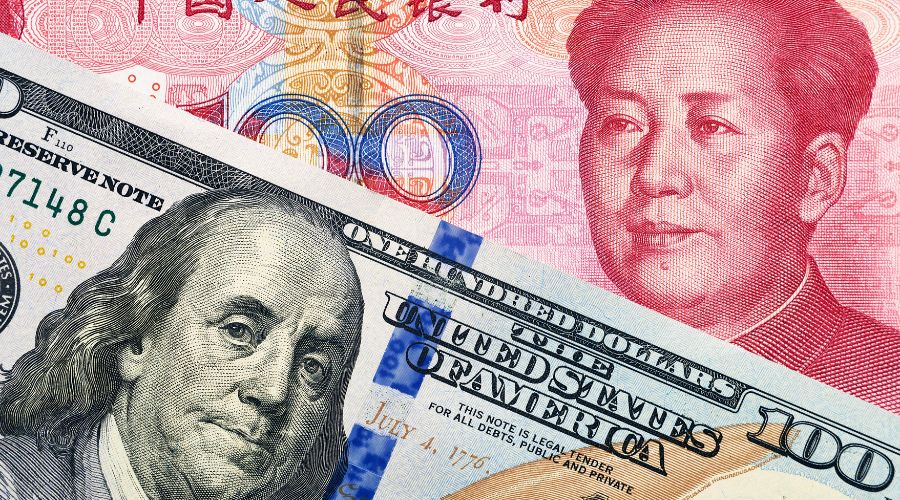
A round of "moderate but sustained" RMB appreciation is underway.
Just last week, the offshore RMB exchange rate rose to 6.9985, returning to the "6-digit prefix" for the first time since September 2024. At the same time, the central bank's central parity has also strengthened significantly, and the market generally believes that the central bank's acceptance of the gradual appreciation of the RMB is increasing.
According to the analysis of a number of institutions, this round of appreciation is not accidental, but the result of three factors:
The US dollar weakens (Fed rate cut expectations are heating up); improved global risk sentiment (geopolitical tensions eased, markets are more willing to take risks); China's asset attractiveness has rebounded (economic data has picked up, stock and bond markets have performed better).
On the whole, the RMB is heading towards its strongest year in the past five years and is currently at a critical stage of the end of the year.
The central bank does not "hard control" the exchange rate, but guides with the trend
Since the beginning of this year, the central bank's approach has been more like "letting the market dominate, but preventing it from getting out of control" - both allowing the exchange rate to fluctuate with the market and preventing unilateral speculation or sharp fluctuations through tools.
In the first half of the year, the RMB weakened against a basket of currencies (RMB index), but this left room for later appreciation against non-US currencies (such as the euro and yen).
Recently, when the market began to push up the RMB, the central bank did not suppress it, but controlled the pace of appreciation on a "gentle slope" through mid-price guidance, expectation management and countercyclical tools - it can rise, but don't skyrocket.
Why is this "breaking 7" important? The key is not the number "6.99", but the signal has changed: in the context of the weakening of the global dollar, the central bank has told the market with a stronger pricing signal - "the RMB can appreciate moderately, but it must be stable and not soar."
This marks that the RMB is moving from the past "defensive mode" (fear of depreciation and passive response) to the "repair mode" (actively returning to a reasonable level).
What is supporting the strengthening of the RMB?
In the past, it relied on a single factor, but now it is a multi-positive force at the same time: China's economy is still resilient, and there is no need to use a "weaker exchange rate" to stimulate exports or maintain growth, and the RMB has the confidence to strengthen steadily. The pressure on the interest rate differential between China and the United States has eased, US interest rates have peaked, China's policy has been stable and loose, and the real interest rate differential is no longer suppressing the RMB as before
Market expectations are reversing: foreign exchange forwards (NDF) show weakening expectations of depreciation; enterprises are more willing to settle foreign exchange (they are more willing to exchange for RMB after earning foreign exchange); funds have begun to flow back to China's stock market and bond market
All of this is shifting market sentiment from "anti-depreciation" to "long RMB". Deeper changes: The RMB has become an "indicator of confidence"
Recently, the media and investors have begun to directly link the appreciation of the renminbi with the inflow of foreign capital into A-shares and the recovery of risk appetite. This means that the renminbi is no longer just a "macro variable" that reflects economic fundamentals, but is becoming a "sentiment variable" that measures market confidence in China
Once this confidence forms inertia, it may reinforce itself - the more confidence, the more money flows in; the more funds, the more stable the exchange rate, and the stronger the confidence.
The tide of a strong dollar has receded, and the external pressure on the RMB has been greatly reduced
In the past two years, the biggest "roadblock" of the RMB has been the strong US dollar. But by 2025, this pressure has weakened significantly: the dollar index has fallen sharply, which the media called "the worst year since 2003".
There are two reasons: the market is betting in advance that the Fed will cut interest rates in 2026; At the same time, there are also concerns about the unclear direction of the Fed's policy and the challenge of independence.
What does this mean?
Even if China's economy is still challenging and the Fed's policy is not fully clear, the "strong dollar", the "general floodgate" that suppressed the RMB in the past, has been loosened. The US dollar may still bring short-term fluctuations in the future, but it is difficult to form a sustained suppression on the yuan.
Why is 2026 a critical window?
If 2025 is the starting year of "weakening of the US dollar + the beginning of the recovery of the RMB", then 2026 is the verification year of "internal and external cooperation + real upward movement of the exchange rate center":
External: The US dollar is likely to continue to be weak; Internal: The central bank will adhere to the "rhythmic and controlled" appreciation strategy - not soaring, but steadily raising the exchange rate center.
More importantly, as long as the domestic economy gradually stabilizes and policies work together, the RMB is expected to change from "passively following the US dollar" to "an active variable reflecting China's economic fundamentals", opening up more room for appreciation.
After "breaking 7", is the RMB still cheap?
Don't rush to say expensive! Models from Goldman Sachs and other institutions show that the yuan is still about 25% undervalued by its fundamentals and is even listed as a "high-certainty investment opportunity". This number may not be accurate, but it sends an important signal: this round of appreciation is not short-term hype, but the beginning of a long-term valuation repair.
How do the funds move when expectations change? The trend of the exchange rate is ultimately determined by cross-border capital flows. In the past few years, many Chinese companies or residents have had a "currency mismatch": exports earned US dollars, but they were not exchanged for RMB in time; There are too many US dollar assets in hand and insufficient RMB allocation.
Once the market expects a shift from "RMB will depreciate" to "RMB will appreciate", these funds will flow back quickly like a tight spring, further pushing up the exchange rate.
What is more noteworthy is that the RMB is expanding from a "settlement currency" to a "financing currency": the scale of overseas bond issuance and financing in RMB is increasing; More and more real trade and financial transactions are starting to be denominated in RMB.
Although it is still far from replacing the US dollar, this change can really increase the global demand and stickiness of the yuan.
Will the appreciation of the RMB really "tighten" the financial environment?
In the traditional understanding, the appreciation of the local currency will make exports difficult and financial conditions tighten.
But if this appreciation is to correct the undervalued state in the past, and the pace is moderate and controllable, and the market expectation is not "rushing", then the actual effect may be the opposite: enterprises are more willing to exchange foreign exchange for RMB (increased foreign exchange settlement); reduced capital outflows; Market confidence and liquidity have improved.
In other words, this is a round of "restorative appreciation", and the pressure on economic growth may not be as great as imagined. What we really need to be wary of is that the appreciation is too fast - that will hit the profits and order expectations of export companies.
The impact on different industries is very different, the appreciation of the RMB, some people "suffer", some people "benefit", the key depends on what you do:
✅ Export manufacturing (such as clothing, electronic OEM, etc.):
facing declining price competitiveness and pressure on profits; However, high value-added industries (such as new energy vehicles and high-end equipment) often rely on technology, brand and supply chain advantages to withstand pressure and even maintain share.
These companies usually use three methods to deal with it: use foreign exchange hedging tools to lock in exchange rate risk; Settle in RMB or local currency instead; Expand diversified markets such as the "Belt and Road" and reduce dependence on a single market.
✅ Import-dependent industries (such as aviation, chips, energy, machinery and equipment):
RMB appreciation = imported raw materials, parts, and equipment are cheaper; Directly reduce costs, increase profits, and enhance investment willingness.
✅ Pure domestic sales or domestic substitution enterprises (such as domestic software, pharmaceuticals, consumer brands):
It is almost unaffected by exports and can indirectly benefit from the recovery of overall economic confidence.
Don't bet on the direction, but prevent risks
No one is sure whether the yuan will rise to 6.8 in 2026, and all forecasts are based on current information and may still be disrupted by policy, geopolitical or global economic changes.
But what is certain is that there is indeed room for valuation repair of the RMB; Market expectations are shifting from panic or unilateral betting to a more rational equilibrium; The coordination of policy, economy and external environment is improving.
In the future, the RMB will most likely take a path of "no haste, rise and fall, and overall moderate upward".
Therefore, the most important thing for enterprises and investors to do is not to guess the rise and fall of the exchange rate, but to use market-oriented tools (such as forwards and options) to hedge risks to avoid hurting the safety of operations and investments due to exchange rate fluctuations.
Rationally looking at trends and managing risks in a solid manner - this is the right posture to deal with exchange rate fluctuations in the new stage.