
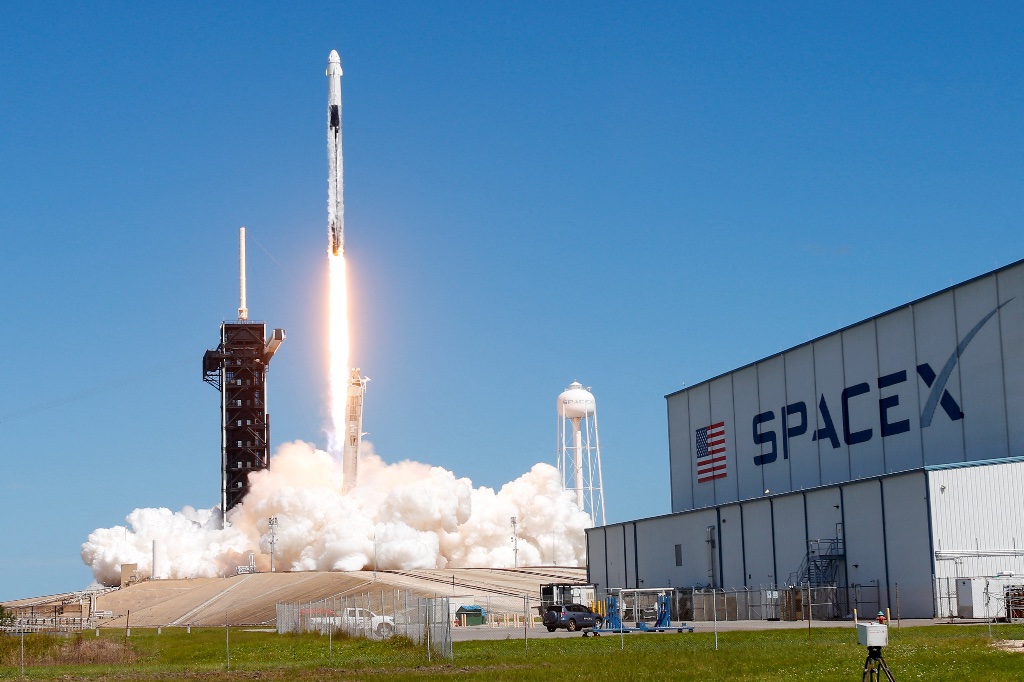
Musk's SpaceX plans to go public as early as the second half of 2026, and the news instantly ignited the market's anticipation for a "super unicorn" IPO.
SpaceX is currently valued at about $1.5 trillion and will raise about $40 billion if it sells a 5% stake as planned — which would break Saudi Aramco's $29 billion record for the world's largest IPO in 2019.
What's more, SpaceX, as a "giant" private company, has stayed away from the stock market for a long time. Its listing could be the trigger for a group of "hundred-unicorns" (unlisted companies with a valuation of more than $100 billion), such as payment giant Stripe, to go to the open market.
These companies have historically chosen private equity financing for the simple reason that private equity can give higher valuations than the open market; there is no need to explain performance to the public every quarter; There is no need to endure stock price fluctuations and public opinion pressure.
However, since the global IPO boom subsided in 2021, public market fundraising has continued to be sluggish. Now, if SpaceX really succeeds in going public and is accepted by the market, it is equivalent to sending a signal to other "super unicorns": it is time to get out of the private equity greenhouse and accept the test of the capital market.
Of course, this is also a big test - are investors willing to pay for a space company that is not fully profitable but has great prospects? The answer will directly affect the landscape of the US stock market in the coming years.
| If SpaceX goes public, will the market "catch up"?
If SpaceX does go public at a valuation of $1.5 trillion and sell a 5% stake, it will raise about $75 billion — not only the largest IPO in history, but even more than the total amount of traditional U.S. IPO financing in the past 13 years and 8 full years (excluding SPACs and closed-end funds).
This means that the capital capacity, trading system and investor enthusiasm of the entire market will face a "stress test".
Paul Abrahimzadeh, a former Citigroup executive and partner at 1789 Capital, believes that "half of the S&P 500 companies have a market capitalization of less than $40 billion. SpaceX is a completely different magnitude - it will definitely attract a large number of institutional and retail investors to rush to buy, and it is a 'must-match' stock. ”
But many people also questioned: Is this valuation really reasonable?
David Erickson, associate professor at Columbia Business School and former head of global equity capital markets at Barclays, said bluntly: "I'm not worried about whether the market has money to buy, what I'm worried about is - is it worth the price?
Judging from the current revenue and business scale of SpaceX or OpenAI, it is difficult to convince people to support a trillion-dollar valuation. In the open market, you have to convince budget-conscious investors that stories alone are not enough. ”
SpaceX's listing is not a question of "whether it can be sold", but "whether everyone is willing to pay for its sky-high valuation with real money". Once listed, it will no longer be Musk's "private dream" and must be subjected to strict torture in the open market.
No matter how good the private equity market is, it is not a "safe"
While the private market now looks well-funded and active, these good days won't last forever.
Morgan Stanley's Colin Stewart is often asked, "Why go public when private equity is so hot?" His answer was very direct: "Today's liquidity does not mean that there will be tomorrow." The economy experiences big fluctuations every 5 to 10 years, and liquidity can dry up overnight. ”
In the past, large companies like SpaceX could provide some liquidity by arranging for employees or early investors to sell shares regularly. But as the company gets bigger and the valuation gets higher and higher, this method is becoming more and more difficult to operate.
Want to keep selling shares at higher valuations? There will be more and more no one to take over. It is better to simply go public and let the open market price and provide real liquidity.
Barclays' Rob Stowe also pointed out that mega-IPOs have a non-negligible impact: "Missing a small IPO of hundreds of millions of dollars has little impact on large funds; But if you miss a star company of $50 billion or even $500 billion, and it rises sharply after listing, then your portfolio may seriously underperform its peers. ”
Abrahimzadeh of 1789 Capital hit the nail on the head: "These 'super unicorns' are so big that no one can afford them. The road of mergers and acquisitions is basically not working, and listing is almost the only way out. ”
Don't blindly chase higher, but lay out the ecological chain in advance
For ordinary investors: SpaceX may have an emotional premium in the early stage of listing, so don't chase it high with FOMO (fear of missing out); Focus on its supply chain and partners: aerospace materials (e.g., carbon fiber, specialty alloys); satellite chip and ground terminal manufacturer; Starlink application scenarios (maritime communications, Internet in remote areas).
For institutional investors: study the fundamentals of the "hundred-unicorn" in advance to avoid being biased by marketing stories; Pay attention to the pace of IPO and market acceptance, and be wary of the liquidity shock caused by "listing together".