
Recently, the real estate industry ushered in a major shock: Vanke, a leading real estate company, announced that it plans to extend (i.e., postpone repayment) a 2 billion yuan domestic bond ("22 Vanke MTN004"). As soon as the news came out, the market reacted violently - the price of many Vanke bonds plummeted by more than 20% in a single day; A-share and Hong Kong stock prices also fell to multi-year lows.
As a benchmark real estate company that was once regarded as the "safest", Vanke is now also facing debt pressure, completely breaking the market illusion that "leading real estate companies will not have accidents" and becoming a "stress test" in the current period of deep real estate adjustment.
Behind this crisis, there are three major problems:
tight cash flow - it is difficult to collect money from selling a house, and money cannot come in; Debt maturity - too much money to be repaid, too urgent; Market confidence collapsed - home buyers and investors are waiting and watching or even retreating.
The next step of Vanke is likely to directly affect the trend of the entire property market in 2026
Vanke's debt extension is not an isolated case, but a microcosm of the plight of the entire industry
Vanke's application for a 2 billion yuan bond extension this time is not an accident, but an inevitable result of the dual pressure of long-term real estate downturn + tight own funds.
On the surface, the crisis comes from two expiring medium-term notes:
"22 Vanke MTN004" due on December 15 (2 billion yuan) "22 Vanke MTN005" due on December 28 (3.7 billion yuan)
The total principal and interest are nearly 5.9 billion yuan, and there is too much money to be repaid in the short term. But the deeper problem is: the house can't be sold.
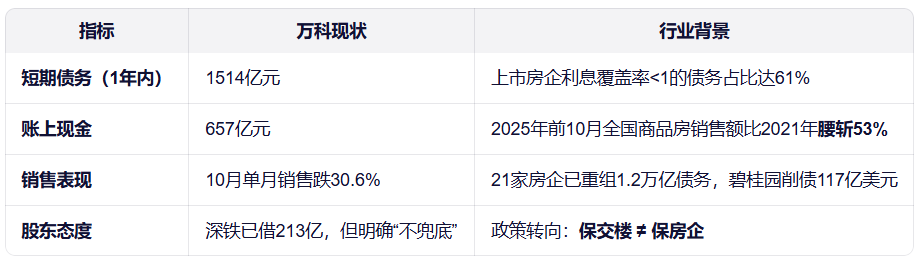
In the first 10 months of 2025, Vanke's sales fell by 9.8% year-on-year; In October alone, it plummeted 30.6%. Sales collection is the "lifeline" of real estate enterprises, and if this line is weak, the solvency will be immediately under pressure.
To make matters worse, as of the end of the third quarter, Vanke had only 65.68 billion yuan in cash on its books, but the short-term debt to be repaid within a year was as high as 151.39 billion yuan, and the capital gap was close to 90 billion yuan, and liquidity was extremely tight.
More importantly, Vanke is not an isolated case. The data shows:
In the first nine months of 2025, the national commercial housing sales were halved more than the same period in 2021 (down 53%); Among listed real estate companies, 61% of debts cannot even be repaid with interest (interest coverage ratio less than 1). Previously, Country Garden had cut its debt by $11.7 billion through overseas restructuring; As of the end of October, 21 insured real estate companies have completed debt restructuring, with a total debt scale of 1.2 trillion yuan.
Nowadays, even "top students" like Vanke have to be extended, indicating that real estate debt risks have spread from small and medium-sized real estate enterprises to leading enterprises, and the concern of "credit collapse" is becoming a reality.
The Vanke crisis is triggering an industry "earthquake"
Vanke's application for debt extension has already affected more than one company, but set off a chain reaction in the capital market, the entire real estate industry and even the macroeconomic level.
1. Capital markets: Panic spreads, credit bonds are sold off
On November 26, a bond of Vanke ("22 Vanke 02") plummeted nearly 30% intraday, directly triggering a circuit breaker; Other Vanke bonds also fell sharply at the same time, and panic quickly spread to the entire credit bond market; Investors have sold bonds of private real estate enterprises, and risk appetite has dropped sharply.
What's even more troublesome is that banks, insurance and other institutions hold a large number of Vanke bonds, and their asset quality is under pressure, which may further tighten loans to real estate companies - which will exacerbate the vicious circle of "financing is difficult→ selling houses is difficult→ and debt repayment is more difficult".
2. Industry ecology: The "halo" of the leader is shattered, and trust collapses
In the past, the market always thought that "Vanke would not fail", but now it can't even hold on, and the "leading belief" is completely broken.
Investors and financial institutions have begun to re-examine the credit risk of all real estate companies; The financing environment has deteriorated sharply, especially for private real estate enterprises, which may face the risk of "loan cut".
Although the major shareholder Shenzhen Metro has provided more than 21.3 billion yuan in loans, it has made it clear: "We do not cover the bottom, we only support it according to market rules." This sentence is equivalent to telling the market that the government will not pay for the debts of real estate enterprises, and the illusion of "hidden rigid redemption" is completely over
Under this expectation, more real estate companies can only survive on their own - selling assets (such as hotels, office buildings, project equity) for cash; seeking cooperative development, or even selling high-quality projects at low prices. But this will lower the overall asset price and plunge the industry into a deeper adjustment
3. Macroeconomic: dragging down upstream and downstream, affecting recovery
Real estate is the pillar of the national economy, and its turmoil will affect a large area: orders for building materials, decoration, home appliances and other industries have decreased; local government land revenue has declined, and financial pressure has increased;
The number of related jobs has decreased, and the job market has been under pressure.
In particular, China's economy is fully turning to high-tech and "new quality productivity", and if the property market continues to be sluggish, it will also hit residents' consumer confidence and slow down the pace of overall economic recovery.
|2026 property market policy main line: ensure the delivery of buildings, destocking, and promote transformation
In the face of the continuous downturn in the real estate industry, the policy direction has been very clear: the core is to "ensure the delivery of buildings, people's livelihood, and stability", and around this goal, a set of risk mitigation mechanisms of "government guidance + market operation + legal protection" have been built.
How to do it?
In terms of finance: broaden the financing channels of real estate enterprises, establish a coordination mechanism, encourage high-quality real estate enterprises to acquire projects of insured enterprises, and prevent unfinished real estate; Judiciary: Open up the connection between "out-of-court negotiation and reorganization" and "court bankruptcy reorganization" to make debt restructuring more efficient, and at the same time strictly prevent enterprises from taking the opportunity to evade debts; For leading real estate companies such as Vanke: do not engage in "direct bottom-up" or "flood irrigation" bailouts, but promote market-oriented means (such as debt extension, asset sales, and introduction of partners) to resolve risks and let the market complete the survival of the fittest.
In 2026, the policy focus will focus on "stopping the decline and stabilizing the situation", mainly from three aspects:
Loosening restrictions on home purchases: cleaning up unreasonable purchase and loan restrictions, first-tier cities such as Beijing, Shanghai, and Shenzhen may optimize regulatory measures, and mortgage interest rates are also expected to be further reduced; Accelerate destocking: promote the monetization and resettlement of urban village transformation, and the government acquires existing housing to help digest the backlog of housing in the market; Promote quality upgrading: Formulate construction standards for "good houses", support the demand for improved housing, and guide the industry from "desperately building houses" to "building good houses".
Jingtai believes that these policies are expected to gradually ease market pressure, but due to the imbalance between supply and demand and market inertia, the effect will not be immediate. In 2026, the property market is likely to still be in the stage of "adjusting and bottoming out" - the bottom is forming, but it will take time for a full recovery.